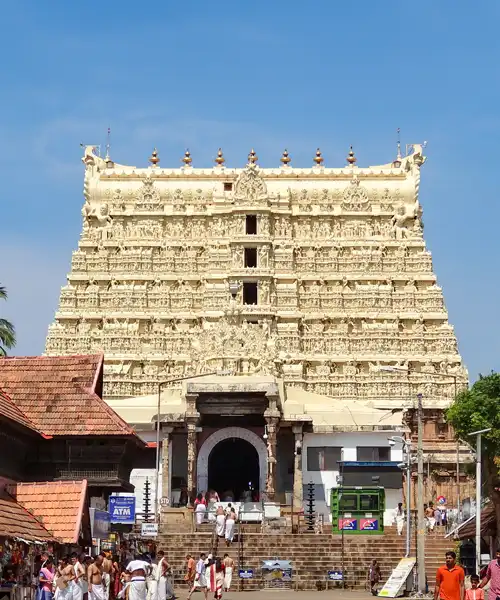
At the center of Thiruvananthapuram, the Sree Padmanabhaswamy Temple is a living example of the spiritual and architectural greatness of Kerala. The temple dedicated to Lord Padmanabhaswamy, a form of Lord Vishnu, is loved for its past, date, and socio-economic status, and the enormous wealth, which is unmatched all over the world. Fortifying the East Fort area, it is considered among the wealthiest temples on earth.
The temple presents a harmonious combination of the two architectural styles of Kerala and Dravidian and dates back to the 8th century. The building is an ancient recognition of craftsmen’s skills and artistry; it has intricate work in both stone and bronze. The main deity, a reclining Vishnu idol of 18 feet, is made up of 12,008 salagramams coming from the banks of the River Gandhaki in Nepal. The idol is visible through three different doors: the first one shows the head and chest, the second one the hands, and the third one the feet.
In front of the holy shrine stands a single gigantic stone slab from Tirumala, the Ottakkal Mandapam, which is beautifully carved. The walls are beautifully decorated with reclining murals of Lord Vishnu, Lord Ganapati, Gaja Lakshmi, and Narasimha Swamy. The temple's gold-plated dhwaja stamba, which is 80 feet high, is its attractive point. The temple’s other architectural gems besides the Bali Peeda Mandapam, Mukha Mandapam, and the Navagraha Mandapa, which has the nine planets on its roof, include the.
One can enter the sanctum through a magnificent hall of 365 and a quarter granite pillars, which are intricately decorated, while the Nataka Sala at the eastern gate is the place where Kathakali is played during the ten-day festival in the Malayalam months of Meenam and Thulam. Being one of the Divya Desams the 108 sacred Vishnu temples this sanctuary is a landing place for people who seek the grace of the reclining Anantha Padmanabhaswamy.
Besides that, this temple has a tight historical relationship with the Travancore royal lineage. In the year 1750, Marthanda Varma dedicated the region to Lord Padmanabha; he made a promise that the kings would be Padmanabha Dasas, or servers of the deity. He started the Bhadra Deepam and Murajapam festivals, the last one of which is held every six years. The temple’s management is still by the trust of the previous royal family, maintaining the traditions of the old times.
With its grand architectural design, performance of sacred rituals, and being a rich cultural heritage item, the Sree Padmanabhaswamy Temple is still going strong in capturing the hearts of the devotees and visitors; it is a perennial icon of Kerala's spiritual and artistic heritage.
Worship Timings - Sree Padmanabhaswamy Temple
Morning:
- 3:30 A.M. - 4:45 A.M. - Nirmalya Darshanam
- 6:30 A.M. - 7:00 A.M.
- 8:30 A.M. - 10:00 A.M.
- 10:30 A.M. - 11:10 A.M.
- 11:45 A.M. - 12:00 P.M.
Evening:
- 4:30 P.M. - 6:15 P.M.
- 6:45 P.M. - 7:20 P.M.
Note: The timings may be different during the festivals or other special occasions.
Dress Code & Entry Rules
Only Hindus are allowed entry.
Men: Mundu or dhoti that reaches the heels must be worn; shirts are not allowed. At the temple entrance, dhotis can be rented. Devotees can also wear dhotis over pants or churidhar for their convenience.
Women: The clothes that can be worn are sari, mundum neriyathum (set-mundu), half sari, or skirt with blouse.
Strict enforcement of the dress code is necessary to gain access to the temple premises.
How to Reach
Thampanoor Bus Stand is located at a distance of approximately 1.7 km.
Thiruvananthapuram International Airport is located at a distance of approximately 5 km.
Thampanoor Railway Station is located at a distance of approximately 1.4 km.
Contact Information
The Executive Officer
Ulsavamadam Building, North Nada Sree Padmanabha Swamy Temple Fort,
Thiruvananthapuram – 695023.
+ 91 471 245 0233
mathilakamofficespst@gmail.com